My Favorite Things
Operationalizing joy to stay coherent in an increasingly incoherent world.

Raindrops on roses
And whiskers on kittens.
Bright copper kettles
And warm woolen mittens.
Brown paper packages tied up with strings
These are a few of my favorite things.
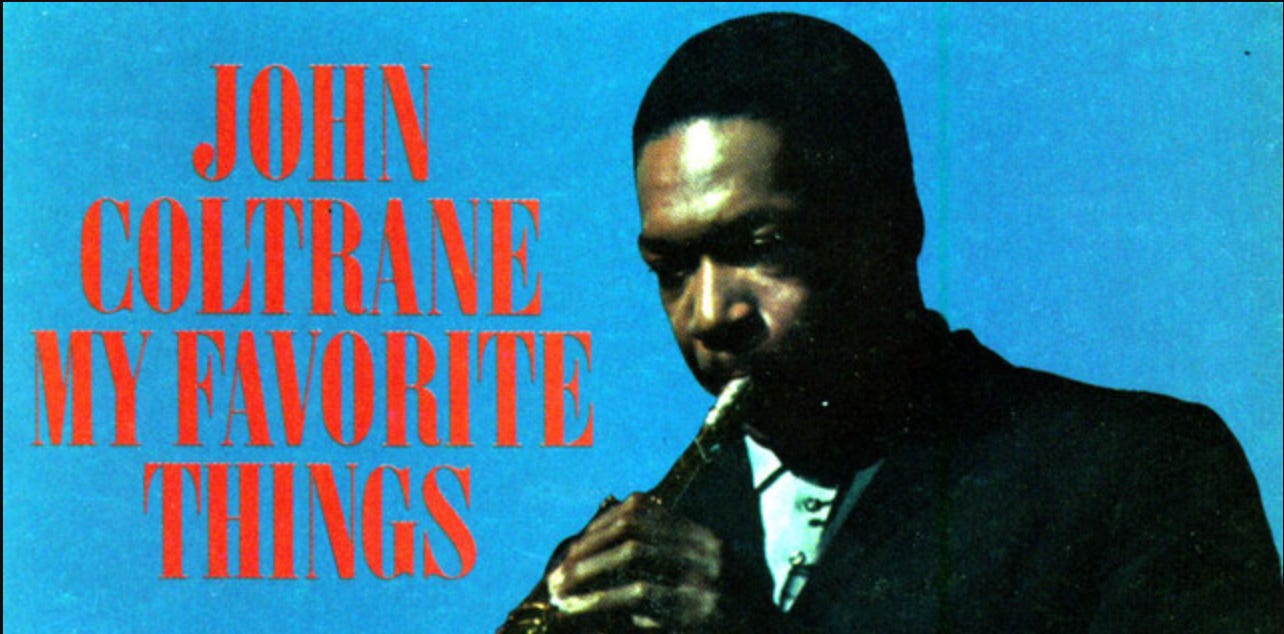
This is by far my favorite song of all time. I've played this song ten thousand times, through halcyon and abysmal days, since I first discovered it in my teens. Originally composed by musical theater deities Rodgers and Hammerstein, The Sound of Music debuted on Broadway in 1959. While most are familiar with the 1965 film adaptation, John Coltrane recorded his studio version of this song in 1961.
To be honest I never paid much attention to the words.
The lyrics seemed nonsensical. Who the eff gives an eff about snowflakes that stay on my nose and eyelashes? And then you consider the context. The song is sung by a terrified adult, to a group of even more terrified children. It's being sung over the sound of booming thunder, an unsubtle reference to bombs falling as Nazi Germany annexed Austria. It is an adult trying hard to be brave, by teaching a bunch of kids a survival algorithm:
Tucked inside the most hostile moments are pockets of joy if you know where to look.
Set in 1938 Austria, The Sound of Music tells the story of a family trying to escape the rise of fascism. The implication here is not that cream-colored ponies and crisp apple strudels could stop an authoritarian regime. Weather can’t change climate. What they do—tiny moments of joy, tenderness, coherence—is provide enough internal lift to survive until conditions change.
When you can’t control the ecosystem you reinforce infrastructure.
External conditions don’t change. Perspective does. Coltrane mercilessly exploits this. Because the melodic structure contains no thirds (music nerd alert) the melody works in both major and minor scales. Happy and sad chords shift back and forth effortlessly, while the melody ignores them. Doorbells and sleigh bells and schnitzel with noodles aren’t just “think happy thoughts and everything will be fine.”
They’re operationalized buoys in a sea of “this is not okay.”
Steve Davis’s upright bass shows the influence of Indian raga, providing a steady pulse as the backdrop for wild improvisation. It’s the sameness we can count on in chaos. Like a heartbeat set in waltz time, it’s a rhythm so sure you can almost ignore its consistency.
The way one might ignore wild geese that fly with the moon on their wings.
When the chords shift from minor to major, McCoy Tyner’s piano solo eases in cautiously. It’s almost as if skies have been overcast for so long he doesn’t trust sunshine. And then he bursts free. The light and air in his playing feel somatic because the melody never asked the framework to change.
Snowflakes that stay on my nose and eyelashes don’t negate the blizzard.
Then there’s Coltrane. There are moments of exuberance and despondency atop the polyrhythmic thrum of Elvin Jones drums. Close your eyes and you can feel the colors change from primary to muted pastels. Solace here isn’t meant to solve. It’s not “chipper” or a positive attitude. It’s a choice of perspective. Sit in the dark for long enough, and your eyes will adjust to the point where you can perceive a single photon.
Silver-white winters that melt into springs don’t provide shelter from the elements.
My friend Cyndie Spiegel calls these Microjoys. They’re not meant to fix everything. They don’t abolish fear. They don’t change circumstance. That doesn’t invalidate them. We acknowledge death by a thousand cuts and dismiss life by a thousand smiles. Dog bites and bee stings may feel like poor metaphor for tyranny. It’s not your job to fix the problems of the world.
It’s your job to stay sane enough to stay in the fight.
On rough days (like today), when I have no choice but to admit that by myself I’m powerless against the churn of big things, it's the smallest things that bring moments of comfort. The memory of my Mom's laughter. The scathing sarcasm of my bestie. Friends who quietly look after others without blowing a horn in front of themselves. Every piece of clothing I own being coated in white fur, thank you Bowie.
The last time someone who really cared for me kissed me.
A practice of gratitude will not solve any of the issues currently plaguing our world. It will help you find a way back to yourself when fear feels overwhelming. Find those things today. A favorite song. Food that tastes like grief. Humans that register as softness. Practices that regulate your nervous system. Focus on moments that lifted you in darkness. They won’t make the world less hostile.
They may help you find just enough beauty inside the ache to keep from coming apart.
We absolutely need our microjoys - even one can make our day. I wrote about Cyndie's book last August and was so delighted to even know the term and apply it; having a word to label the experience kind of doubled the joy of the moment. https://annettenaber.substack.com/p/unruffled-moment-of-calm-and-beauty-1e8
The symbolism of this song has never escaped me; And I remember the first time I heard Coltrane's iteration. My Dad, was very much into blues and jazz.. and because of him, I listen to that genre of music often. Thank you, for reminding me of something I'd forgotten.